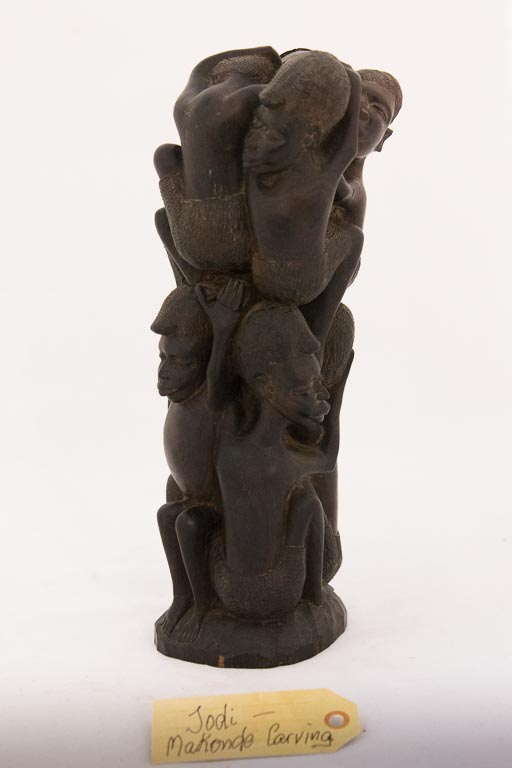
Several years ago, I can’t remember how long, but I was doing an overland trip from London to South Africa, and a friend of mine had said, “will you send me back a carving?” And I said, “Okay.” I didn’t know that much, and when I was in London I walked past a window and they were having a Makonde carving exhibit, and I said, “Geez that looks interesting and guess what? I’m going to be in Tanzania.” So when I got there we went to several of the carving families, and this is a Makonde carving. The Makondes probably started in about the 1700s, I think they started in the Congo, Zaire now, and then migrated over into Mozambique-in the northern part of Mozambique and then the southeastern part of Tanzania, which is where I bought this; and then due to political situations they moved up in Kenya. But a lot of the carvings were started in soft wood, so they don’t have very much history because most of those were done in by the termites. When they moved into this area, Tanzania, they started using the ebony tree which are much harder so the ants wouldn’t attack them. The carvings like this, you can see that there’s lots of people on top of this, this would be an ancestral. […] You can see that these are the ancestors here, and everybody lives on top of their ancestors, their past.
This belongs in an African Ethnic Museum
Exhibited by Jodi Cerny
Transcript edited by Serena Washington
 That Belongs in a Museum!
