In 1938 in the country of South Africa in a little town just north of Cape Town there was a small museum, and the small museum employed a woman [named] Marjorie Latimer, and Marjorie Latimer would make a habit of going down to the docks and looking at the trawlers, the big fishing ships coming in dropping off their catch, looking for fish that she could add to the museum.
On December 23, 1938 she went down to a trawler and she saw a fish; she described it as ‘the most beautiful fish I’d ever seen; five feet long, pale mauve blue with iridescent silver markings’. She had no idea what the fish was but she knew she hadn’t seen it before. She sent it to a biologist and he said ‘this is a fish that they hadn’t seen since the cretaceous [period].’
And pretty soon ‘coelacanth’ became a household word.
The fourth coelacanth ever found was brought to the Field Museum [in Chicago], and the Field Museum had a habit of taking out collections for their members night, and they used to pull this poor coelacanth out of its metal box of formaldehyde and put it on a counter for people to look at.
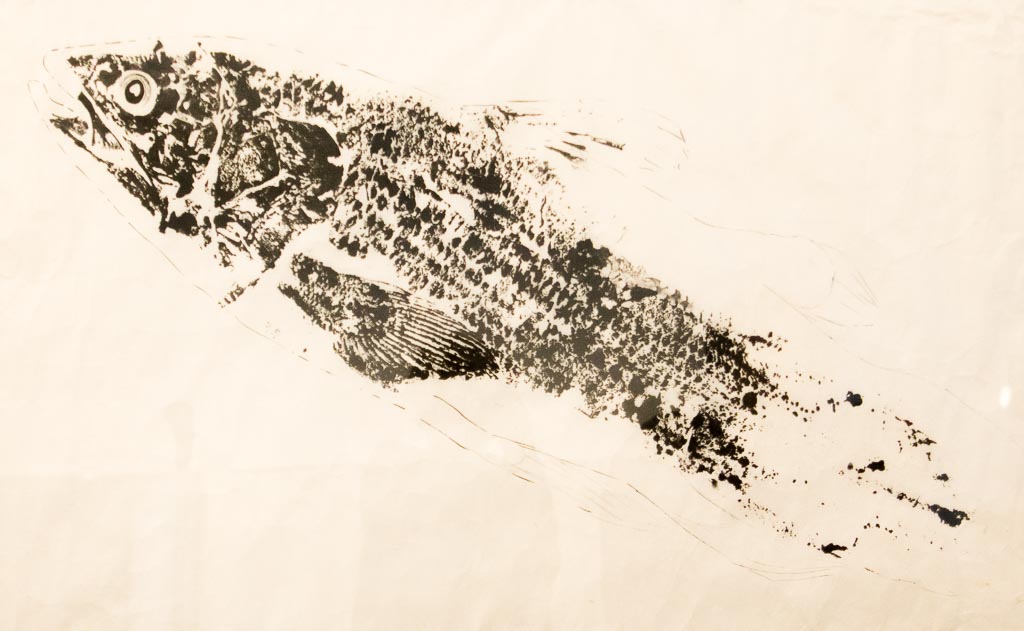
And in the early 1980s there was a tradition of [Field Museum employees and their friends] going to one of the staff offices after members night and doing shots. And who would have thought that in that room there would be a person who was an expert in gyotaku, which is Japanese fish printing, where you have a fish and you put ink all over it, put a piece of rice paper over it, and end up with the impression of a fish.
So there was this person who was an expert in gyotaku and [also in the room was] the person who was in charge of putting the coelacanth back in its metal box. They got together, and about the time that the ink was put all over the fish, and the rice paper was being put on the coelacanth, everybody had this collective thought of ‘museum ethics’, and pretty soon the ink was wiped off the fish, it was put back in the tank, the sheet of paper that came off the fish was rolled up and put away, and they didn’t see it for eighteen years.
And I was working on a project with [a colleague], and she says ‘Jack I have something for you’ and she gives me this rolled up sheet of paper, and it’s the coelacanth.
Exhibited by Jack MacRay
Transcript edited by Susan Golland
 That Belongs in a Museum!
